Engineering Finishing Secrets: How to Guarantee Sharp and Straight Drywall Edges Using “Corner Beads”?
Engineering Finishing Secrets: How to Guarantee Sharp and Straight Drywall Edges Using “Corner Beads”?
12 October 2026
In cladding and dry construction projects, the moment of truth that separates a “standard commercial finish” from a “premium engineering finish” lies in the minute details—specifically in the “corners and edges.”
Upon inspecting any project, the first thing a consulting engineer or owner notices is the straightness of the intersecting walls and ceilings. Gypsum boards naturally have fragile edges that are prone to crumbling when cut. Leaving these edges without structural protection leads to ugly visual waves, rapid joint compound cracking, and immediate damage if the corner suffers even a mild impact.
This is where the most critical installation accessory comes in, one that some installers overlook to save costs: Corner Beads. How do these beads work? And how do they guarantee that you deliver your project to the highest quality standards?
What Are Corner Beads? And Why Are They Mandatory?
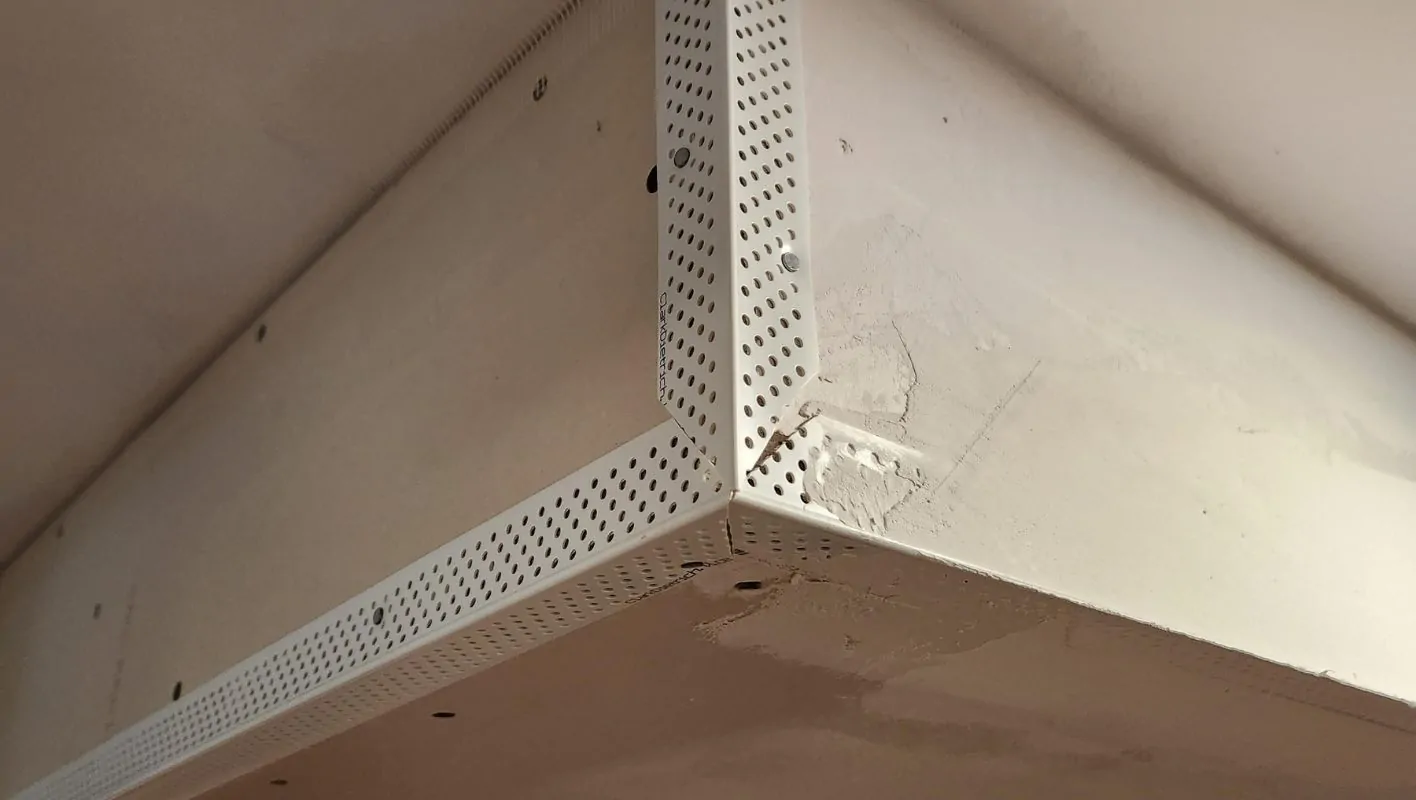
Corner beads are linear profiles made from rust-resistant galvanized steel or aluminum, typically formed at a 90-degree angle. They are fastened to the exposed outside edges of gypsum boards before the mudding (joint compound) and painting stages.
Using them is not just a cosmetic choice; it is an engineering necessity for three main reasons:
-
Plumb & Straight Edges: The metal bead forces a perfectly straight path (like a ruler) along the edge of the wall or ceiling, hiding any waves or imperfections resulting from cutting the gypsum boards.
-
Impact Resistance: Wall and corridor corners are the most exposed to friction and impact (e.g., during furniture moving). The corner bead acts as a solid shield that absorbs the shock and prevents the gypsum core from shattering.
-
Crack Prevention: Working in tandem with the joint compound, the corner bead binds the two intersecting boards together and prevents cracks caused by structural expansion and contraction.
Execution Secrets: Types of Beads and Their Modern Applications
The world of modern finishing requires precise accessories that meet “minimalist” design demands. Here are the most important types and how to utilize them:
1. Standard Corner Bead
-
Application: Used for all exposed 90-degree outside corners of walls, columns, and lighting bulkheads.
-
Execution Secret: They come perforated to allow the joint compound to penetrate the holes, creating a highly durable chemical and mechanical bond between the bead and the board.
2. Shadow Line Bead (W-Bead / L-Bead)
-
Application: This is the secret behind luxurious “Floating Ceilings” that do not appear to touch the walls. It completely eliminates the need for traditional gypsum cornices or crown molding.
-
Execution Secret: It is installed where the gypsum ceiling meets the wall, creating a black geometric gap (a shadow) of 1 to 2 cm. This gap not only provides a high-end architectural look but also absorbs ceiling vibrations and prevents any cracks from appearing between the ceiling and the wall over time.
3. Archway Beads (Flexible Beads)
-
Application: Designed for circular ceilings, arches, and curved organic designs.
-
Execution Secret: It features one perforated and notched edge that allows the bead to be bent and shaped by hand to smoothly match any geometric curve, ensuring soft, rounded edges without kinks.
3 Golden Rules for Flawless Corner Bead Installation
-
Galvanization is Key: Beware of using cheap or non-galvanized metal beads. The moisture in the joint compound will cause the bead to rust immediately, and this rust will bleed through as ugly yellow stains that ruin the final paint job.
-
Correct Fastening: The metal bead must be fastened using fine-thread drywall screws every 20 cm, or by using a corner crimping tool. Avoid using regular nails, which can shatter the board’s edge.
-
Gradual Coverage (Feathering): The metal bead must be covered with 2 to 3 thin coats of joint compound. The compound should be applied and smoothed with a wide drywall trowel (10 to 12 inches) to feather the bead into the wall, making it completely invisible.
The Integrated Dry Construction System from “Verona Decor”
At Verona Decor, we understand that the success of a dry construction project relies on the integration of all its elements. Therefore, we do not just supply high-quality gypsum boards; we offer contractors and engineers a complete finishing system.
We provide a comprehensive range of galvanized metal beads (Standard Corner Beads, Shadow Line Beads, and Archway Beads) that comply with international (ASTM) standards. They guarantee rust protection, perfect geometric straightness, and a long lifespan for your project.
Don’t let small details ruin the quality of your massive work. Contact the sales management at “Verona Decor” today to get wholesale prices for all drywall accessories and metal framing worthy of your engineering projects!